
Continue
You’re going to love Descript.
Descript is a different kind of video & podcast editor that gives creators superpowers like:
Create your next project in Descript. It’s free.
Descript is a different kind of video & podcast editor that gives creators superpowers like:
Get started for free
Oops! Something went wrong while submitting the form.
Continue
You’re going to love Descript.
Descript is a different kind of video & podcast editor that gives creators superpowers like:
Create your next project in Descript. It’s free.
Descript is a different kind of video & podcast editor that gives creators superpowers like:
Get started for free
Oops! Something went wrong while submitting the form.
Continue
You’re going to love Descript.
Descript is a different kind of video & podcast editor that gives creators superpowers like:
Create your next project in Descript. It’s free.
Descript is a different kind of video & podcast editor that gives creators superpowers like:
Get started for free
Oops! Something went wrong while submitting the form.
Continue
You’re going to love Descript.
Descript is a different kind of video & podcast editor that gives creators superpowers like:
Create your next project in Descript. It’s free.
Descript is a different kind of video & podcast editor that gives creators superpowers like:
Get started for free
Oops! Something went wrong while submitting the form.
March 27, 2026

Dependicus: a new tool for monorepo dependency governance

Descript's new Dependicus presents you with information in the form of dashboards and issue tracker tickets, rather than opening PRs.

Steve Landey
,
In this article

The existing tools for automating dependency upgrades all focus on opening pull requests to address CVEs. But that's not enough. APIs change, minimum runtime versions increase, behavior shifts in subtle ways.

We built Dependicus to help you navigate this environment at scale. Rather than opening PRs, it presents you with information in the form of dashboards and issue tracker tickets. You can use that rich context to plan major upgrades, or fire off coding agents to deal with minor API changes. It supports multiple ecosystems today, and it’s designed to grow.

Dependicus helps you see the big picture

In the JavaScript world, you've got limited options for getting a broad view of your dependencies. At Descript we use pnpm, which is the best of the JS package managers, but getting an overview of 200 packages to find duplicate dependencies and general issues is tedious. pnpm is not optimized for fast querying of this kind of information, even if the information is available. Dependicus scrapes everything it can in one go, then presents it to you as a spreadsheet. It’s a static site you can deploy however you want. You run it in CI, and it’s always up to date, no waiting.
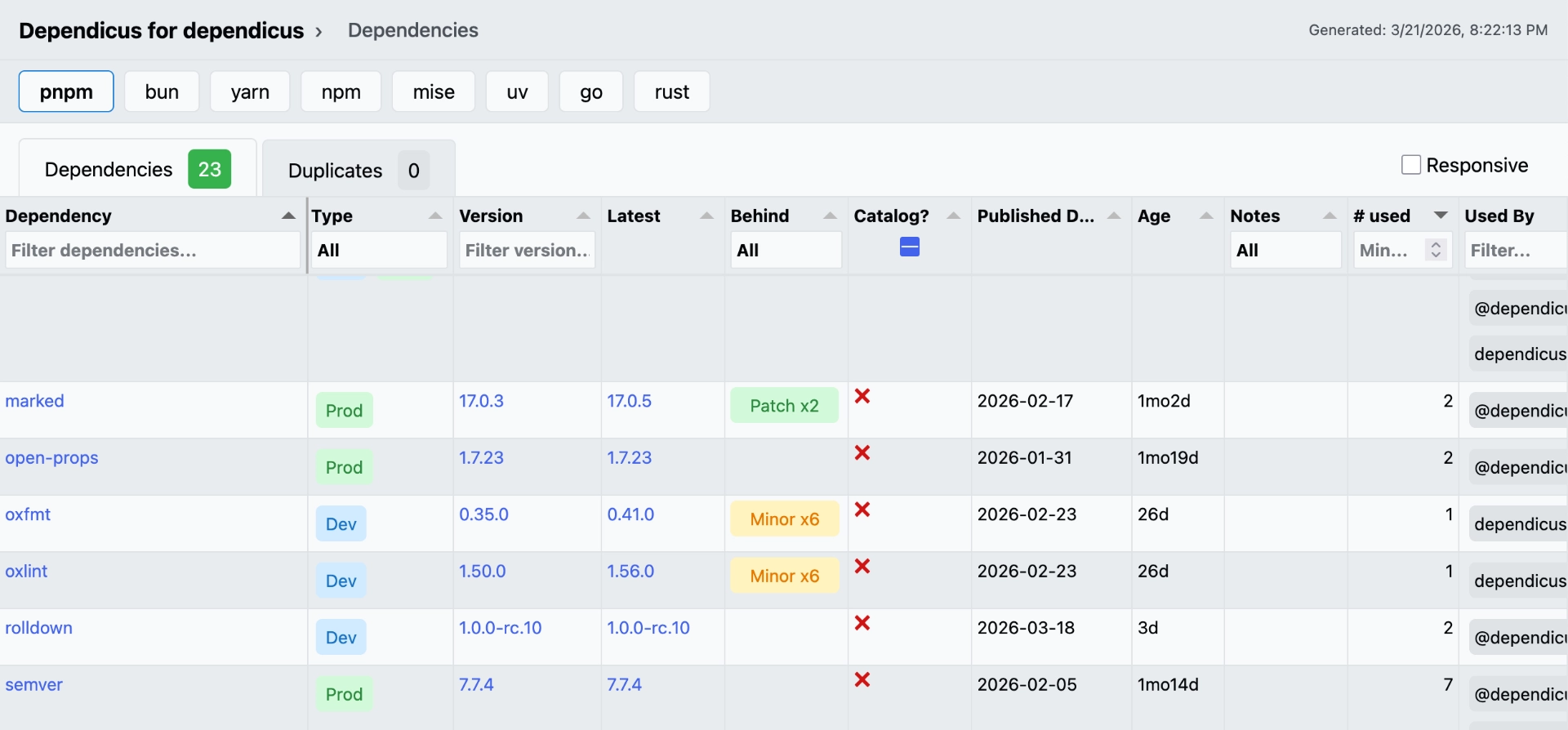
‎If you click on a dependency, it’ll take you to a detail page showing you every individual version between the one you have installed and the latest. Versions are pulled from the package manager (in this case npmjs.org), and Dependicus uses heuristics to locate changelogs, tags, and releases, showing them when possible.
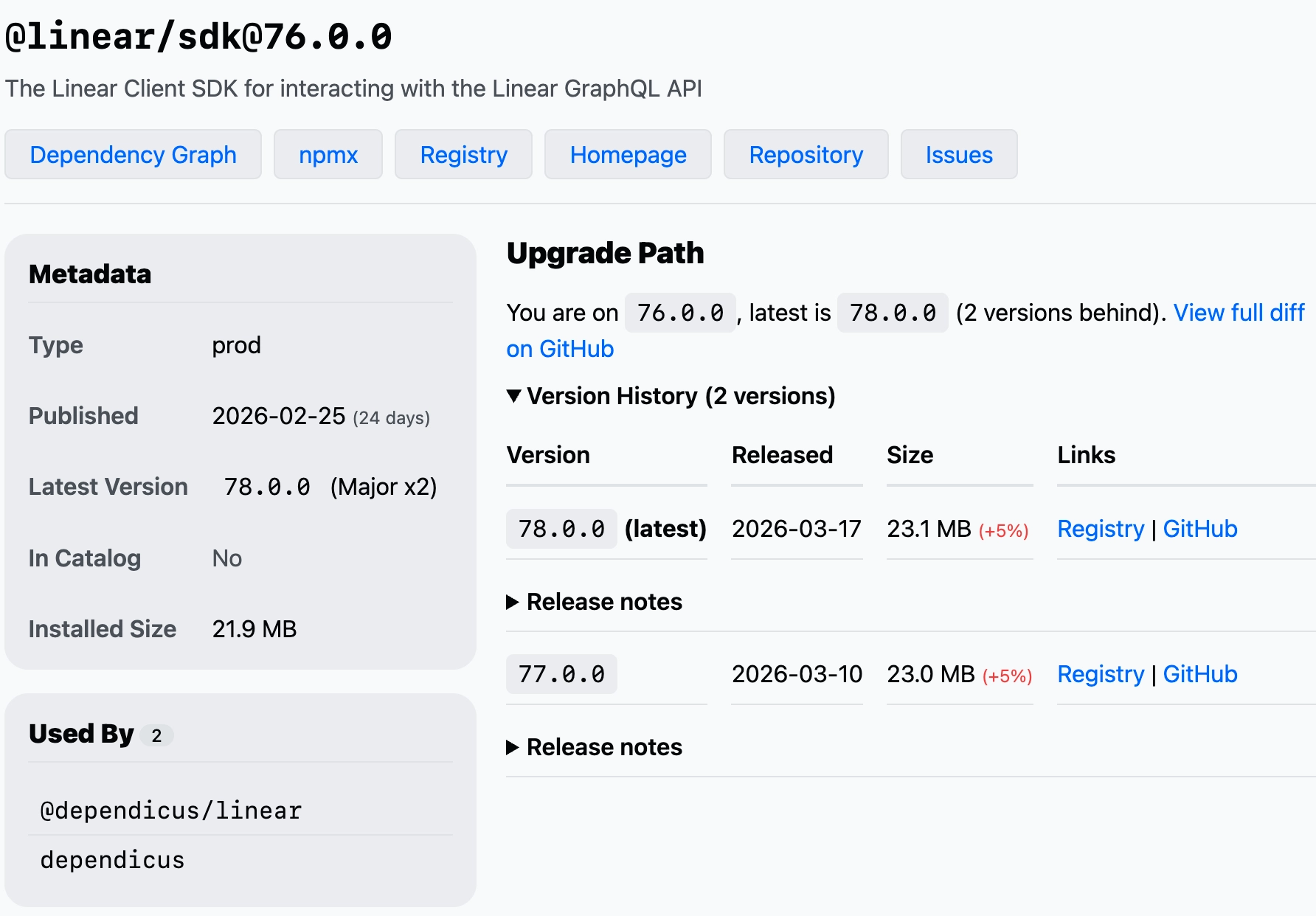
This same view is available for Python, Go, Rust, and Mise dependencies, with level of detail depending on what each package manager provides, and what tags and releases the project has.

Dependicus helps you plan with tickets, not PRs

When dependency updates come with API changes, you can’t rely on mechanical processes to do updates. The updates become tasks competing with other tasks for priority. In the old PR-based style of Dependabot and Renovate, it’s on you to manually create these tickets, or build automations that sync PRs to tickets. The existing systems have “security alerts,” but in a world of sliding window compatibility with browsers, Node.js versions, and OS versions, security alerts are, again, the least-impactful-on-your-time reason to update.

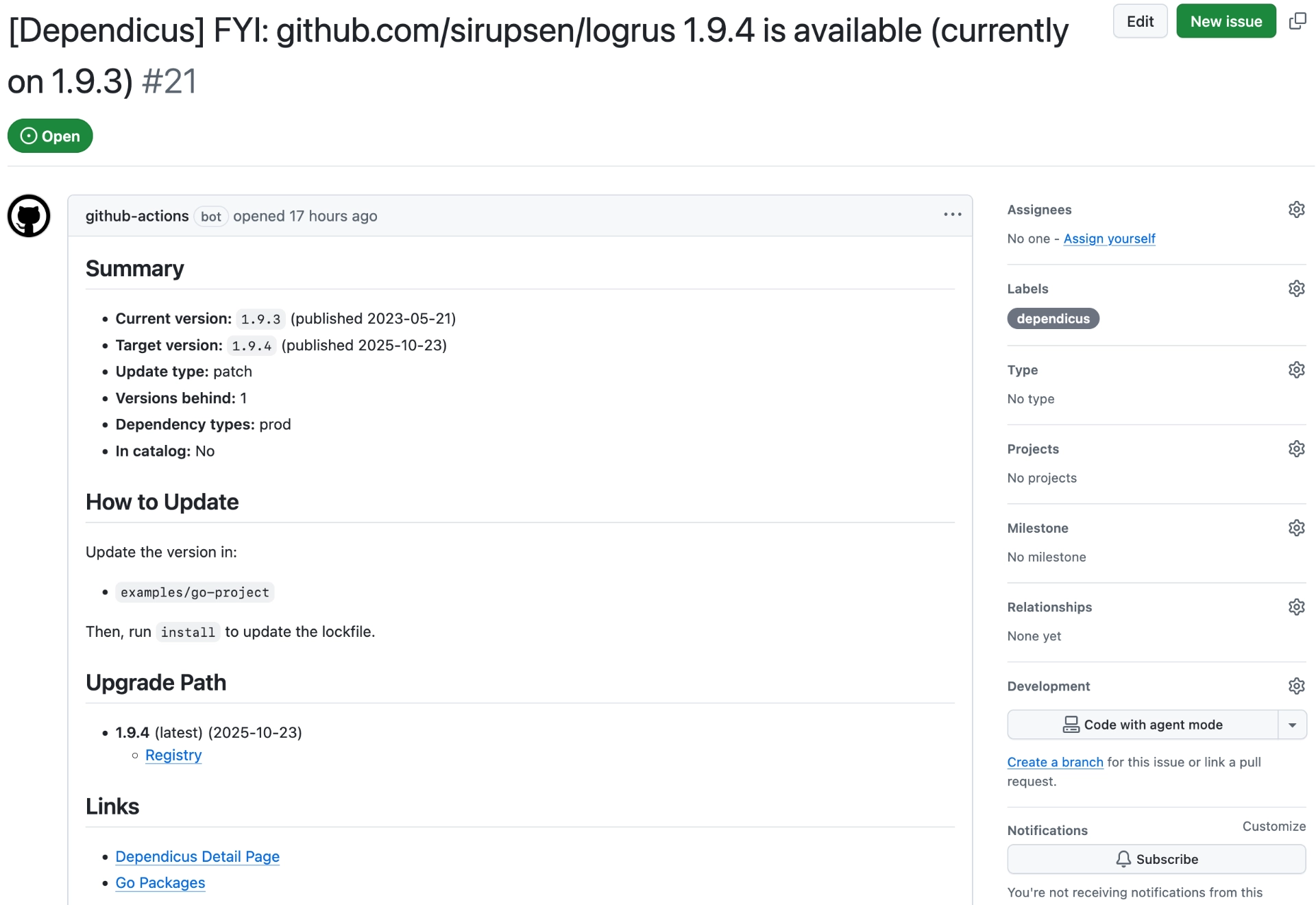
Dependicus inverts the flow of information. It doesn’t create pull requests. Instead, it creates Linear issues or GitHub issues. (No JIRA or Asana support yet—patches are welcome.)‎

It's up to you how the tickets are created, and what you do with them. At Descript, we often assign update tickets directly to coding agents, which can do the mechanical changes and anything else that can be verified with typechecking and tests.

Agents sometimes “notice” that a cluster of dependencies need to be updated together, such as @opentelemetry/ packages, and saves us the trouble of trying to wrangle five PRs at a time. Other times, we’ll put the ticket in a sprint, or track it for a longer-term plan.

Dependicus will comment (rate limited) as new versions are released, so there’s a single source of truth until we get around to doing the update. And we can add our own comments, so that if we do end up assigning the ticket to a coding agent, it has better information and is more likely to do the right thing.

It’s easy to start

Dependicus can be run with minimal configuration.‎

# speeds up fetching of changelogs and tags
export GITHUB_TOKEN=<a GitHub token>

pnpm dlx dependicus@latest update --html 
bunx dependicus@latest update --html 
yarn dlx dependicus@latest update --html 
npx dependicus@latest update --html

open ./dependicus-out/index.html

You can find more detailed CI examples here: https://descriptinc.github.io/dependicus/ci/

If you run into trouble, please start a discussion.

May your build always be green.

Share this article

Get free recording and editing tips delivered to your inbox

Thank you for subscribing!
Oops! Something went wrong while submitting the form.
By subscribing, you consent to receiving marketing emails. You may unsubscribe at any time.

Related articles

Go deeper, make better video

Descript is an all-in-one editing platform that makes creating video as easy as editing text, with AI tools that reduce the drudgery so you can focus on making something good.

Try it free ->

Dependicus: a new tool for monorepo dependency governance

Rather than opening PRs, Dependicus presents you with information in the form of dashboards and issue tracker tickets.

The existing tools for automating dependency upgrades all focus on opening pull requests to address CVEs. But that's not enough. APIs change, minimum runtime versions increase, behavior shifts in subtle ways.

We built Dependicus to help you navigate this environment at scale. Rather than opening PRs, it presents you with information in the form of dashboards and issue tracker tickets. You can use that rich context to plan major upgrades, or fire off coding agents to deal with minor API changes. It supports multiple ecosystems today, and it’s designed to grow.

Dependicus helps you see the big picture

In the JavaScript world, you've got limited options for getting a broad view of your dependencies. At Descript we use pnpm, which is the best of the JS package managers, but getting an overview of 200 packages to find duplicate dependencies and general issues is tedious. pnpm is not optimized for fast querying of this kind of information, even if the information is available. Dependicus scrapes everything it can in one go, then presents it to you as a spreadsheet. It’s a static site you can deploy however you want. You run it in CI, and it’s always up to date, no waiting.

‎If you click on a dependency, it’ll take you to a detail page showing you every individual version between the one you have installed and the latest. Versions are pulled from the package manager (in this case npmjs.org), and Dependicus uses heuristics to locate changelogs, tags, and releases, showing them when possible.

This same view is available for Python, Go, Rust, and Mise dependencies, with level of detail depending on what each package manager provides, and what tags and releases the project has.

Dependicus helps you plan with tickets, not PRs

When dependency updates come with API changes, you can’t rely on mechanical processes to do updates. The updates become tasks competing with other tasks for priority. In the old PR-based style of Dependabot and Renovate, it’s on you to manually create these tickets, or build automations that sync PRs to tickets. The existing systems have “security alerts,” but in a world of sliding window compatibility with browsers, Node.js versions, and OS versions, security alerts are, again, the least-impactful-on-your-time reason to update.

Dependicus inverts the flow of information. It doesn’t create pull requests. Instead, it creates Linear issues or GitHub issues. (No JIRA or Asana support yet—patches are welcome.)‎

It's up to you how the tickets are created, and what you do with them. At Descript, we often assign update tickets directly to coding agents, which can do the mechanical changes and anything else that can be verified with typechecking and tests.

Agents sometimes “notice” that a cluster of dependencies need to be updated together, such as @opentelemetry/ packages, and saves us the trouble of trying to wrangle five PRs at a time. Other times, we’ll put the ticket in a sprint, or track it for a longer-term plan.

Dependicus will comment (rate limited) as new versions are released, so there’s a single source of truth until we get around to doing the update. And we can add our own comments, so that if we do end up assigning the ticket to a coding agent, it has better information and is more likely to do the right thing.

It’s easy to start

Dependicus can be run with minimal configuration.‎

# speeds up fetching of changelogs and tags
export GITHUB_TOKEN=<a GitHub token>

pnpm dlx dependicus@latest update --html 
bunx dependicus@latest update --html 
yarn dlx dependicus@latest update --html 
npx dependicus@latest update --html

open ./dependicus-out/index.html

You can find more detailed CI examples here: https://descriptinc.github.io/dependicus/ci/

If you run into trouble, please start a discussion.

May your build always be green.

Featured articles:

No items found.

Articles you might find interesting

AI for Creators

Personas: The best way to get better results from AI

Unlock the potential of AI with personas. Learn how to improve performance, collaboration, and problem-solving using different persona types.

AI for Creators

How Descript Built Video Regenerate & Translation

We built AI video tools that work instantly on any speaker. Here's what it took to solve lip sync, handle messy real-world footage, and ship to thousands of users

AI for Creators

5 things designers don’t need to learn about designing for AI

Discover why designers should focus on existing knowledge over new AI trends. Learn about user-centric design principles for successful AI product creation.

AI for Creators

Vibe-coding victory: How a non-programmer built his perfect QA tool

A QA engineer with zero coding background built a tool that generated 364 test images for evaluation in minutes

Related articles:

Share this article

Get started for free →